Showing posts with label Lake Kivu. Show all posts

Sunday, August 8, 2010

Separate Worlds

One of my colleagues is leaving Goma, taking a new job in Bangui (Central African Republic). I’m not sure if I envy her, or feel glad that I’m not going-; it’s a big promotion, but CAR sounds like a tough place, for a variety of reasons.

In any case, she can’t leave without a proper send-off, and we host a party at my boss’ house, on the shore of the lake, a lakeside villa with a gazebo and a view that would cost $20 million were it anywhere else, but instead rents for about $2000 per month. It’s hard to imagine more beautiful scenery or better weather, but it comes with trade-off of seeing the degree of inhumanity humans can inflict on each other. Add one of the most active volcanoes in the world on the outskirts of town, a lake filled with billions of cubic meters of poisonous methane and carbon dioxide, and the raw scars of a genocide that killed 800,000-plus people on the opposite shore, and there’s a reason why a popular nickname for this place is ‘hell in paradise.’

All of that aside, the party goes off without a hitch, except for a lack of ice. The electricity is off throughout the city today– no electricity, no ice. After four unsuccessful stops, we give up on trying to find ice, and settle instead for a blowup swimming pool in the gazebo, which we fill with cool water- everyone will have to enjoy their Primus, Mutzig, Sprite and Fanta semi-chilled, the best we can do. Nobody seems to mind though- everyone at the party has either lived in or is from the developing world, and warm beer is normal when electricity is iffy. There are plenty of goat kebabs, large plates of French fries, and cabbage salad- I even spring for a cake at the supermarket, a chocolate creation with ‘FELICITATIONS ET BON VOYAGE’ written in frosting across the top. My colleague has decided that the dress code for her going-away party is African pagne fabric, so the party is packed with blue flowery shirts, printed pictures of various saints on dresses, and a sport coat made from yellow and red Turbo King beer fabric-(slogan: Une Affaire d’Hommes (A Man’s Business). My colleague Jacques takes the prize, however, with a matching shirt and pant combination made of embroidered Primus Beer print-the explosive combination of red, yellow, blue, and dancing women would be enough to wake your average person…in a coma.

Something surprises me at the party though, something I’ve rarely seen in the years I’ve worked in Africa. Typically at parties like this, where both local staff (Congolese, in this case) and expats are invited, there are really two separate parties. The Congolese all hang out off to the side, drinking Fanta and joking in Swahili; the expats are in the other part of the room, drinking beers and mixed drinks, and trying to hear each other over “Tainted Love,” “Get Up, Stand Up,” and whatever the latest hit of the past three weeks happens to be. Some of this can be chalked up to the music, I assume; Bono’s humanitarianism notwithstanding, U2 doesn’t exactly have a huge following around here, and the average mzungu back home isn’t exactly up on the latest in the Papa Wemba or Koffi Olomide catalog.

This time though, the two groups mingle, a great surprise. An Irish guy from Mercy Corps indulges in Travolta-esque Saturday Night Fever antics, while Jonathan, our Congolese-born and Ugandan-educated Monitoring and Evaluation Officer, shakes it in the middle of a circle of dancing Congolese and expats. Jules, our Congolese Non-Food-Item program manager, belts three fingers worth of Bacardi and launches himself into the crowd.

On the edge of the circle, I see Bienvenu, our Logistician, joking in French with my colleague, the guest of honor.

“C’est interdit pour toi de partir. Je ne le permets pas,” he says. ‘You’re not allowed to leave. I won’t permit it.’ My colleague smiles and suggests that Bienvenu comes to Bangui instead.

And on it goes, with Americans, Italians, British, and Congolese having a good time- the beer flows, the music goes on, and my colleague gets quite a goodbye. I’m still struck by the fact that locals and internationals are mingling as much as they are- you really don’t see that frequently.

It’s part of a larger issue, I think. Although both Congolese and foreigners live in Goma, in many ways we live in completely separate worlds. Yes, we drive the same lava-rock strewn roads, breathe the same dust, and battle the same mosquitoes, but for the most part our lives split there. Most Congolese shop at the local markets, buying bread, manioc, fish, beans, and meat- it’s inexpensive, and not far away. Most expats go to Shoppers or Kivu Market, the two big grocery stores in town, where virtually everything is imported- water, milk, and candy come from Kenya and Uganda, but chocolate, cheese, spices, and AquaFresh toothpaste all come from the US, China, France or Belgium, with a price reflecting the 10,000-mile trip. There are Congolese who shop at these places too, of course, but they tend to be the relatively well-off professionals, for whom buying something imported is a stretch, but not impossible. The restaurants I go to with my foreign colleagues are far, far out of reach for the majority of people here, and usually are packed with groups of mzungu- most of the Congolese there are serving drinks and carrying plates.

I’m not saying this is fair, and it isn’t particularly nice, but it’s the reality of life in a place like this- the disparity is enormous. We live parallel lives from the people we’re ostensibly here to serve, and it requires a mental gearshift to pay laborers a decent wage of $3 per day, and go to Petit Bruxelles in the evening with friends for a $20 steak. I understand how exploitative that sounds, but it goes back to something I’d written about earlier- living at the same level as the people you’re here to serve isn’t part of the job description. Attempting to do so would be almost entirely pointless- difficult for you, and patronizing for people here.

Living life on a different plane isn’t normal, but I’m not sure if there’s any other way to do this job. NGOs and international organizations aren’t going to be able to retain people if they can’t promise them a decent quality of life– I saw that firsthand in Sudan with a previous position in a different organization. It’s a difficult shift for many of us, having served as Peace Corps volunteers, or something similar, where that’s the explicit purpose of why you’re in a community. That integration, while admirable, isn’t really the goal in the NGO life, at least not directly. Of course it’s a good thing to cultivate local friendships and relationships, but the point of coming to a place like Goma is to do what you can to help, not to become Congolese. If that means living a life apart, despite the consequences, I think that’s the price of admission.

That ticket can be a steep one though, a feeling like I’m constantly missing out. There’s an entire other side of Goma that I never see. I pass it on the street, see it from a distance, or simply have no idea about it. Some things are probably best not to see- this is ‘hell in paradise,’ after all. Other things, I’m sure I’d regret missing- if I knew about them. I started doing this work, at least in part, to see as much as possible. In that, I’ve succeeded, experiencing things I never would have imagined- New Year’s Eve in Yaoundé, playing Hacky-Sack with a Chadian toddler, and a sunset over Masisi Territory and Lake Kivu that would make the most hardened cynic gasp at the utter beauty. I’ve also smelled reeking fish in the Yaoundé Central Market, discovered that the same toddler I played hacky sack with died of Malaria before her third birthday, and know that the waters of Lake Kivu were responsible for one of the single worst Cholera outbreaks in history… Parallel tracks, indeed.

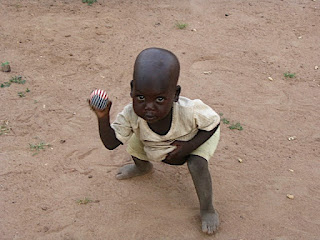


I suppose it comes to this; as I continue to move along I have mental pictures of Chad, Uganda, Niger, Sudan, Cameroon, and Congo. Living a life apart though, what I’m mostly seeing, unfortunately, are the broad outlines.

DRC #12-Lake Kivu Paradise, Apr. 10

Yes, Lake Kivu really is this beautiful...

Sunday, March 14, 2010

DRC #1-Welcome to Goma

Back in the days when this was the Belgian Congo, Goma used to be something of a resort town for the colonial settlers. With the scenery around here, it's easy to understand why... Unfortunately the authorities here are very touchy about taking photos in town, so there's only so many pictures I can post- I'll do what I can though.

We now return to our regularly scheduled emergency...

“Nah-than-iel, I wanted to talk with you about something.” Christophe, the Country Representative and my boss in Yaoundé is calling me, his English spoken with a strong Francophone Belgian accent.

…And just like that, my time in Cameroon ends and the next chapter begins.

“I was in touch with the regional office, and they wanted to discuss a position in Congo with you,” Christophe continues. “Would you potentially be interested?”

I pause a minute before I say anything, many considerations flashing through my mind. Congo. This is a place that’s been synonymous for decades with war, corruption, dictatorship, dysfunctional infrastructure, and everything else that gives Africa a bad reputation. Truly the ‘Heart of Darkness,’ as it was famously called by Joseph Conrad. Working in Congo would mean saying goodbye to much of the comfort and stability that have come with living in Cameroon, a developing, but largely together place, at least in the cities. It’d mean heading back into the maw of emergency work, having already experienced similar situations in Chad, northern Uganda and southern Sudan- my days of DSL at home, spring rolls at the Vietnamese restaurant, and cruising down the national highways at 110 km/hour would be over, replaced by emergency needs assessments, UN helicopter flights, and awful stories of flight from disaster and other miseries. Do I really want to give up the relatively comfortable life of working in ‘development’ for its rougher, harsher, and more intense cousin, ‘emergency?’ That’s exactly what this would mean. So, on one hand it’d mean saying goodbye to a fairly comfortable life- on the other, it’d be a huge opportunity; my salary would more than double, and I could have the distinction of putting Chad, Sudan, and DRC on my CV, the true humanitarian disaster trifecta.

“Yes, I’d definitely consider it,” I tell Christophe. “What would I need to do?”

One 10-minute ‘interview’ (more of a casual chat) with the Country Representative in Kinshasa, and a brief conversation with the head of the sub-office, and it’s done- I’m leaving Cameroon, next stop Goma, eastern Democratic Republic of Congo (DRC), where I’ll be managing emergency Water/Sanitation and Education operations for CRS. Less than two weeks later I step off the jetway at Yaoundé/Nsimalen Airport onto a waiting Kenya Airways 737, next stops Douala, Nairobi, Bujumbura, Kigali, and Goma. Landing at the small terminal in Kigali, it’s immediately obvious what they say about Rwanda, that it’s a country going places. Following the horror of the 1994 genocide, people have said that the country turned a corner, and is on the way to becoming a well-developed and organized place where things work, in other words, not your typical African nation. The current president, Paul Kagame, has been called the ‘Napoleon of Africa,’ and seems determined to drag his country out of the morass of corruption and poverty that seems to hinder everything in this part of the world. Many people have said that Kagame has overseen this development at the price of true democracy, however, so it’s not as if everything is perfect. Perhaps an analog might be the government of Singapore, which turned a backwater into a global hub, but did it at the expense of civil liberties. Under the surface many of the of the old wounds and tribal hatreds undoubtedly endure, but it’s difficult to see much evidence of this on my brief drive through Kigali’s impeccably clean and manicured streets, with tall buildings and activity everywhere.

“Voici Gisenyi et Goma,” our driver says, referring to the Rwandan border town first. Here are Gisenyi and Goma, the place I’ll call home.The city quickly gives way to the countryside as we climb up steep green mountainsides offering incredible vistas of the landscape below. The highway (and it can legitimately be called as such) is well-paved, striped, and has large white pillars marking every kilometer. It’s a three-hour drive from Kigali to the eastern border Rwanda shares with its enormous neighbor DRC, perhaps 25 times its size, or greater. Goma sits directly on the border, making Kigali far more accessible than the Congolese capital Kinshasa, more than 1,500 impenetrable jungle-filled kilometers to the southwest. Driving through the mountains of Rwanda, we suddenly reach a point where we’re overlooking a body of water that looks as big as one of the Great Lakes in the US, ringed with green mountains and the glint of many thousands of tin roofs in the late-afternoon sunlight.

The border crossing is surprisingly easy, and once we cross, the change is immediate. The well-paved road disappears, replaced by cracked and potholed tarmac; the buildings look less well-constructed, and everything has a more run-down feel to it.

Like Gisenyi, Goma sits on the shore of Lake Kivu- back in the days when this place was the Belgian Congo, Goma used to be something of a resort town. The weather is consistently pleasant, the views are stunning, and the black volcanic soil coming from Mount Nyiragongo, 12 km to the north, enables farmers to grow every type of fruit and vegetable imaginable. Unfortunately Goma has become has become known for other things over the years, none of them good. In 1994, at the height of the Rwandan genocide, waves of Hutu and Tutsi refugees poured across the border into Goma and hastily-arranged refugee camps on the shores of the lake. In the midst of a natural paradise, conditions quickly became hellishly grim, and a cholera outbreak only added to the misery. Cholera is an incredibly contagious disease, and by the time the epidemic had burned itself out a few weeks later, thousands were dead. To make things worth, North Kivu province, of which Goma is the capital became the scene of some of the worst of the fighting during the DRC’s multiple civil wars in the 1990s. As if to ensure that this place could never get a break, that it was cursed despite the idyllic setting, Mt. Nyiragongo erupted in 2002 and sent an inferno of lava cascading through town, largely obliterating the central business district. The last kilometer of the airport runway was buried in lava, and to this day cars crawl along the dried lava flow, leading to streets that are made entirely of large rocks. Driving anywhere in town, with the exception of the handful of recently paved roads feels like going on one of the test courses you see at Land Rover dealerships in the US or Europe, only real, and for kilometers at a stretch.

As the scene of so much misery, human-caused and otherwise, Goma has become a humanitarian and NGO hub, and any international nonprofit worth it’s 501c3 status has a presence of some sort here, and as such, this place is something of a boomtown. In addition to the NGOs, MONUC, the UN peacekeeping mission Congo (and largest of its kind in history) has set up a major operations base here, and the massive salaries the UN fonctionnaires bring with them (as well as the comfortable salaries of NGO workers) have sent prices skyrocketing for everyday items. Imported goods are expensive wherever you go, but a box of Corn Flakes doesn’t generally cost $12 except in NGO-stan, places like Goma, Juba, and N’Djamena. Expatriates in the developing world, with the exception of Peace Corps volunteers and missionaries (although even them to an extent) always live something of a life apart from the communities in which they live, but in Goma the divide feels especially dramatic. Foreigners (myself included) live in enormous villas with tile floors, spacious rooms, comfortable furniture, generators to cover for the regular power outages, all surrounded by massive walls and razor wire. Contrast this with the house of the average Congolese family in Goma, which in many cases wouldn’t be fit for animals in the developed world. At Shopper’s Market, the store where all the UN and NGO staff seem to shop, 200 grams of imported foie gras costs $49, but the vast majority of people in town struggle to earn more than a dollar or two a day. I don’t know if there’s any way to avoid this disparity; it seems simply to be fact of life in this part of the world, and in this career.

It can be hard to think of Goma as a ‘hardship post,’ a place where I’m receiving ‘danger pay.’ I think of this the other night when I go a party hosted by someone working for UNICEF. The house sits on the shore of Lake Kivu, surrounded by a stone dock and manicured garden of rolling lawns and tropical flowers. The weather is cool and pleasant, and the slight breeze makes the moonlight ripple on the shore of the lake. I chat with other expats like myself, drinking Absolut and snacking on crackers and imported French cheese. Someone’s iPod blares a mix of upbeat party tunes, and more English is being spoken than anything else. Looking across the lake it’s easy to forget that in a setting as perfect as this thousands have died needlessly and will continue to die from pointless war and easily preventable disease. That’s the paradox of Goma and other places like it, I guess- relative luxury in the midst of suffering. Yes, my life isn’t as comfortable as what I had in Cameroon, but it’s pretty damned nice- one look around is all I need to figure that out. It’s not that this sort of inequality should be the acceptable status quo, but for the moment this is how things are, and it’s time to adapt. This is where I’ll be living, and I may as well find a way to work within it; now entering bizarro-world, population plus-one.